
Master IELTS vocabulary relating to happiness with keywords and texts to help you excel in speaking, writing, reading, and listening.
Everything you need for Academic Writing Task 1
In these lessons, you'll learn how to tackle graphs, charts, tables, maps, floor-plans, processes and natural cycles.
Writing Task 1: Multiple graphs, charts and tables (Book 20)
Tips on how to deal with a mix of graphs, charts and tables in Writing Task 1.
Multiple charts in IELTS Writing Task 1
The charts show the main reasons for study among students of different age groups and the amount of support they received from employers.
IELTS maps and plans: describing future changes

In this lesson, you’ll learn how to describe IELTS maps and plans (‘before and after’ changes) when they related to the future.
Vocabulary for IELTS Writing Task 1
In this lesson you’ll learn less common vocabulary for IELTS Writing Task 1, taken from real-life graphs and charts.
IELTS dynamic graphs: how to organise information
In this lesson you’ll learn 2 ways of organising information clearly when describing IELTS Writing Task 1 dynamic graphs.
IELTS Writing Task 1: how to tackle complex tables
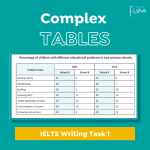
In this lesson you’ll learn how to deal with a table which has 3 sets of complex data to compare.
You’ll learn how to organise your paragraphs and identify key features. The lesson includes a model answer, video and interactive practice.
IELTS Writing Task 1: how to tackle a complex bar chart
This bar chart is the most difficult one I have ever seen. Here’s what to do when you’re faced with something similar in the real exam. This lesson includes:
– a model answer
– 12 essential grammar points
– an interactive practice quiz
IELTS Writing Task 1: how to describe pie charts
Pie charts require some specific language that is related to proportions and percentages. In this lesson you’ll learn how to use that language.
IELTS Writing Task 1: dynamic charts (UK migration)

In this video lesson taken from my Coaching Course, you’ll learn how to describe a dynamic chart and avoid common mistakes.
How to use ‘rise’ and ‘raise’

What’s the difference between rise and raise? Learn how to use both of these words accurately in IELTS.
How to use ‘the former’ and ‘the latter’ in IELTS
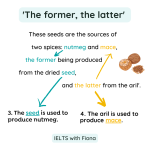
Learn how to use ‘the former’ and ‘the latter’ to make your writing more formal and academic and to avoid repetition.
How to use ‘twice as much/many’

‘Double’, ‘twofold’ and ‘twice as much’ or ‘twice as many’ are advanced strucures used on IELTS Writing Task 1 but they’re easy to learn.
How to describe a natural cycle or process diagram in IELTS Writing Task 1

This lesson will teach you how to describe a natural cycle for IELTS Writing Task 1.
IELTS Writing Task 1 map: how to describe ‘before and after’ diagrams

The IELTS Writing Task 1 floor plan and ‘before and after’ maps require a little thought and preparation if you’ve never done one before. Here are some guidelines.
IELTS linking words: how to use the present participle (ing)
In this lesson about IELTS linking words, you’ll learn how to use the present participle (-ing form) to make your writing more complex.
IELTS Writing Task 1: 6 ways to make predictions
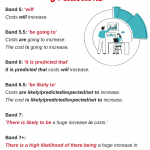
In Academic Writing Task 1 graphs, you may need to make predictions. A simple way to do this is to use ‘will’. In this lesson, you’ll learn more complex ways.
IELTS Process Diagram: 5 easy steps
IELTS Process diagrams are not difficult. Follow these 5 easy steps to help you get Band 7 in 20 minutes.
IELTS Grammar: How to use the Past Perfect tense

The Past Perfect is a useful tense to master for describing change in Academic Writing Task 1, and storytelling in both GT Writing Task 1 and Speaking Part 2.
Describe a process in IELTS Task 1 (energy from coal)
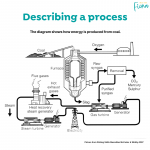
Here’s my quick guide and model for IELTS Task 1 Writing – how to describe a process.

