Learn how to use “the more… the more” in IELTS Writing. This guide explains the grammar in simple terms and gives clear examples for Task 1 and Task 2 essays, plus practice exercises to improve your score.
Grammar tips for IELTS
In these lessons, you'll understand and master key grammar for high IELTS scores. Clear lessons and examples help you write and speak accurately and confidently.
A complete guide to making predictions in IELTS
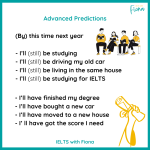
You need to make predictions in all parts of the IELTS test. This lesson focuses on high-level expressions, idioms and structures to predict the future.
Quantifiers: few, a few, little, a little in IELTS

In this grammar review we look at how to use few, a few, little and a little in IELTS writing, and how they are tested in Reading and Listening.
The Power of Past Participles
This is your complete guide to Past Participles (3rd form) and how to use them to improve your writing and to understand more in the Listening and Reading tests.
This lesson includes 3 videos to help you get a better understanding of how to use Past Participles in different contexts.
Reference words for IELTS: SUCH

Did you know that ‘such’ is commonly used in the Reading Test to give you the right answer?
In this lesson, you’ll learn how ‘such’ works as a reference word (to refer BACK to previous information) so that you can use this high-level structure in the Writing Test.
IELTS Grammar: countable and uncountable nouns

In this IELTS Grammar lesson, we examine all the uses of countable and uncountable nouns, with common mistakes.
Nouns as adjectives: a simple tip to avoid mistakes

When can you use nouns as adjectives? This lesson shows you how to avoid common mistakes with noun modifiers in IELTS Writing.
How to use ‘willing to’ and ‘want to’

Are you saying ‘I’m willing to’ when really you mean ‘I want to’? In this lesson you’ll find out the differences so you can use them correctly.
How to use ‘It’s (not) worth it’

This is a common grammar mistake that I see on many IELTS websites!
Learn how to use ‘worthy’ and ‘worth’ accurately in writing and speaking, with some useful idiomatic expressions.
How to use ‘rise’ and ‘raise’

What’s the difference between rise and raise? Learn how to use both of these words accurately in IELTS.
IELTS Vocab: affect and effect
The difference between ‘affect’ and ‘effect’ and how to use them accurately in IELTS Writing and Speaking.
How to use ‘despite’ and ‘in spite of’ in IELTS Writing Task 2

There are very important grammatical differences between ‘despite’ and ‘in spite of’ and ‘although’. Learn how to use them corrrectly here (with video and interactive practice).
‘Not only, but also’ and other forms of inversion

‘Not only, but also’ is a powerful structure that you can use in both Writing and Speaking. This lesson reviews the grammar of inversion caused by this structure.
How to use ‘the former’ and ‘the latter’ in IELTS
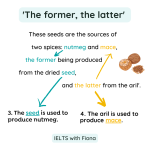
Learn how to use ‘the former’ and ‘the latter’ to make your writing more formal and academic and to avoid repetition.
How to use ‘twice as much/many’

‘Double’, ‘twofold’ and ‘twice as much’ or ‘twice as many’ are advanced strucures used on IELTS Writing Task 1 but they’re easy to learn.
How to use ‘although’ to show concession in IELTS Writing

Learn how to use ‘although’, ‘though’ and ‘even though’ to produce an outstanding Task 2 conclusion.
IELTS conditionals: a complete guide

In this complete guide to IELTS conditionals, you’ll learn how to use all conditional sentences specifically for the IELTS test.
‘-ing’ vs infinitive: 10 simple rules
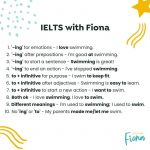
Ing or infinitive verbs have a complex set of rules, but here are some tips on how to master their use.
Grammar for IELTS: will vs going to
If you learnt in school that ‘will’ is the Future Tense, do this lesson about ways of talking about future PLANS.
Grammar for IELTS: Modals of Deduction (Listening about Ireland)

Modals of deduction can help you answer questions in both the IELTS Reading and Listening tests. This lesson will show you how.

